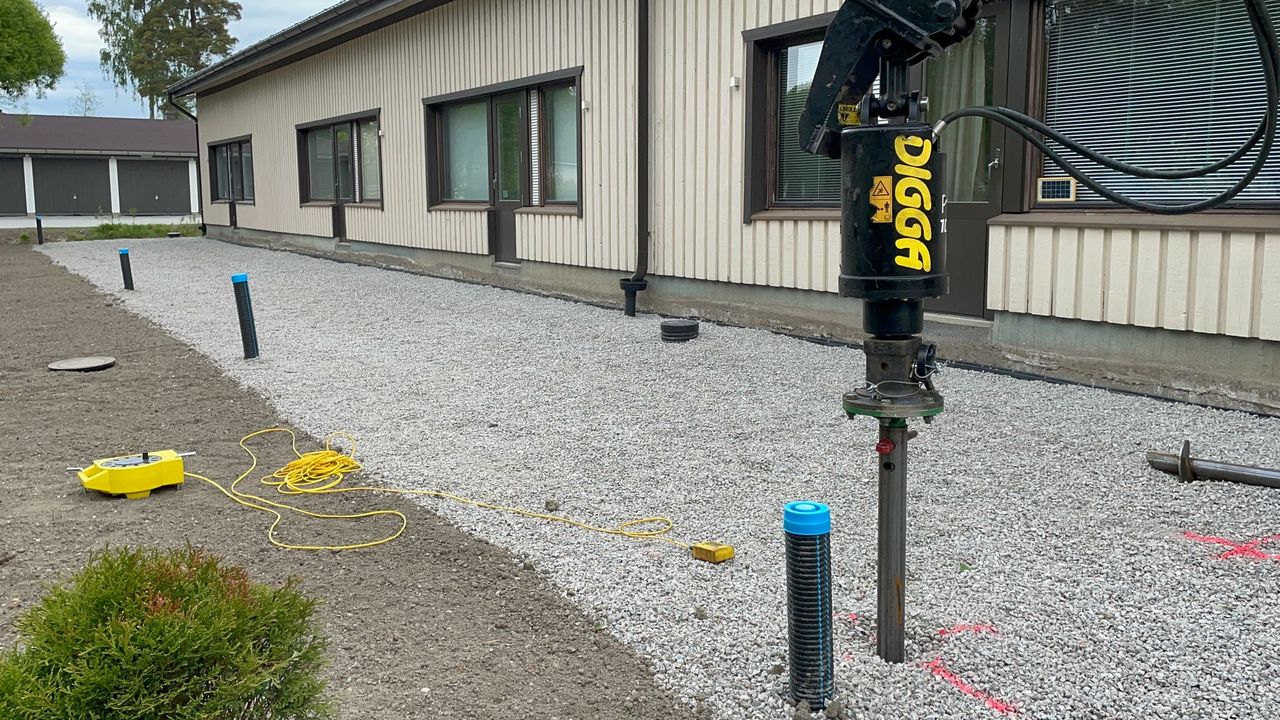
It’s not often you begin a construction project in the middle of nowhere. You almost always have surrounding buildings to consider. And that brings its own set of challenges. Whether it’s domestic refurbishments, urban developments, or projects within occupied schools or hospitals, your construction and foundation choices can easily affect the surrounding structures, with the greatest concern being vibration. While noise is an irritation, ground movement and vibration hold the potential to not just cause disruption but also to cause structural harm. Which is why foundation choice matters. And why helical screw piles often make the most sense.
The Role of Helical Screw Piles in Avoiding Vibration and Structural Risk
Why vibration matters
When construction takes place close to an existing structure, even relatively small movements can be a concern. Older buildings may have shallow or unknown foundations, while adjoining structures can have different settlement characteristics.
Excavation can also remove or disturb supporting ground, while some piling techniques generate significant vibration during installation. On a busy urban site, there may be additional concerns around noise, dust, access, and disruption to neighboring properties.
This is why foundation design should consider not only the loads of the new structure but also the relationship between the proposed works and everything around it.
A lower-impact approach to foundations
Helical screw piles minimize ground disturbance. Rather than requiring extensive excavation, they are rotated into the ground using a single groundworks vehicle. Where space is really tight or the site is particularly sensitive, installation can be managed with a handheld auger or even manually. There’s no spoil to remove, nominal vibration, and minimal site disruption. This can make helical screw piles particularly useful for projects where access is restricted or where construction is taking place close to existing buildings.
Keeping occupied buildings working
Schools, hospitals, and other occupied buildings present an additional challenge: construction needs to happen without unnecessarily disrupting the people using the building. Reducing excavation, spoil removal, noise, and vibration can help create a more manageable working environment. Screw piles also do not require concrete curing, meaning the foundation can be ready for loading immediately after suitable installation and verification.
Of course, low-impact installation does not remove the need for proper planning. Existing foundations, underground services, ground conditions, and structural loads all need to be assessed before you start work.
Design and installation need to work together
For best results, it’s always a good idea to treat foundation selection as part of the wider structural strategy. Soil conditions, pile configuration, loading requirements, and installation conditions all influence performance. Because while installation torque can provide useful information during installation, design and verification ensure that you get it right first time.
Build close, but build carefully
Working beside existing structures does not have to mean accepting excessive disruption. With the right foundation choice, it is possible to reduce excavation, limit vibration, and make better use of restricted sites.
Helical screw piles can provide a practical, low-impact foundation option for a range of different construction projects. But they’re particularly ideal where conventional methods may create unnecessary disturbance. So, if your early design discussions focus around low-impact and supporting the continued integrity of existing structures, helical screw piles may just be the solution that you’re looking for.
To discuss your project and find out whether screw piles could provide a suitable foundation solution, get in touch with UK Helix.