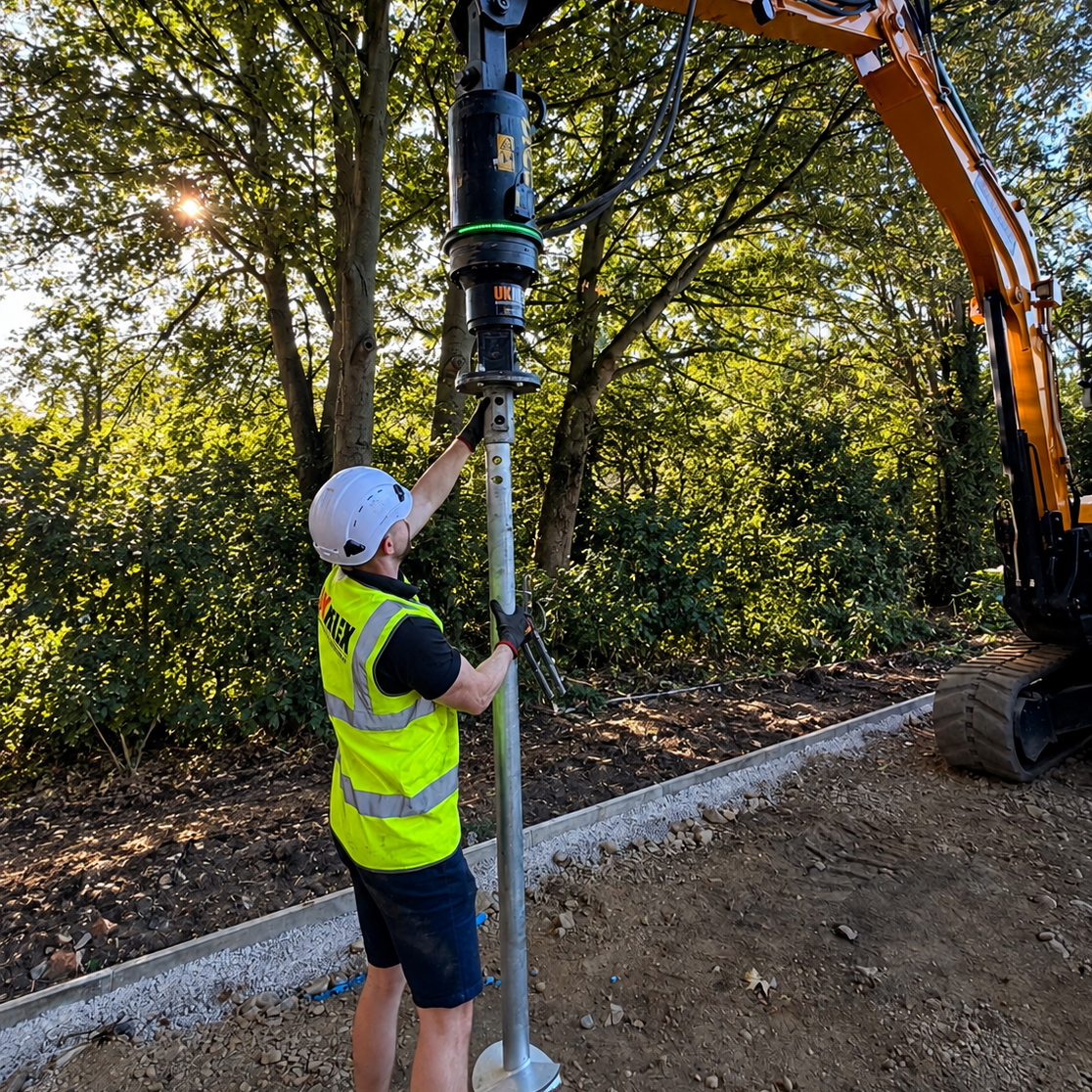
Building around established trees can make an otherwise straightforward project considerably more complicated. And when those trees are protected by a Tree Preservation Order (TPO), the stakes are even higher. It’s not simply a case of avoiding the trunk or canopy. The root system also needs to be considered, particularly where proposed foundations fall within a Root Protection Area (RPA). So, what foundation solutions are available when excavation needs to be kept to a minimum?
Installing Foundations When a Tree Preservation Order is in Place
Understanding TPOs and root protection areas
A TPO is a legal protection placed on a tree, group of trees, or woodland by a local planning authority. Among other things, it prohibits cutting down, uprooting, or wilfully damaging protected trees without the necessary consent. Government guidance also makes clear that cutting roots can constitute prohibited work.
But even where a TPO doesn’t directly cover the proposed building footprint, the tree’s roots can still create a significant construction concern. This is where the Root Protection Area becomes important.
BS5837:2012 provides recommendations for managing the relationship between trees and construction. It includes the use of RPAs and construction exclusion zones to help protect retained trees during development. Understanding the RPA early can prevent expensive redesigns later.
Why traditional foundations can be problematic
Strip foundations, pads, and other conventional solutions generally involve excavation. That can mean removing soil, cutting through roots, compacting surrounding ground, and changing the conditions in which the tree’s root system operates. And it doesn’t necessarily take a large excavation to create a problem.
So, where a tree needs to be retained, arboricultural considerations should always form part of the foundation design from the beginning. An Arboricultural Impact Assessment and, where required, an Arboricultural Method Statement can establish the constraints and identify appropriate construction methods.
The aim is to design the foundation around the tree rather than trying to make the tree fit around the foundation.
Avoiding excavation with screw piles
This is where helical screw piles can provide an alternative. Rather than excavating a large area and filling it with concrete, screw piles are rotated directly into the ground. This means considerably less soil disturbance and no requirement for conventional foundation trenches.
The piles can also be positioned individually, allowing the foundation layout to be designed around known constraints. Where appropriate, this can help avoid larger roots while still providing the structural support required by the proposed building. It’s this that can make screw piles so useful for extensions, lightweight structures, decks, walkways and other developments where working space is restricted, or excavation within an RPA presents a challenge.
Working alongside arboricultural requirements
Of course, screw piles aren’t a way of simply ignoring tree protection requirements. Every site is different, and the relevant TPO, RPA, ground conditions and planning conditions need to be understood before installation begins. BS5837 also recognises the importance of an arboricultural method statement where construction activities could affect retained trees. For this reason, foundation engineers, builders and arboricultural consultants need to work together. The pile layout, installation method and access requirements should all be considered alongside the arboricultural recommendations.
Getting this right at the design stage is much easier than trying to solve a root protection problem once construction has started.
A practical foundation solution for sensitive sites
Working on a site with a TPO doesn’t necessarily mean that development has to stop. It does mean that the approach to construction needs to be carefully considered. Where conventional excavation could threaten tree roots, helical screw piles can offer a lower-impact alternative. With minimal excavation, limited ground disturbance, and flexible positioning, they can help provide a practical foundation while respecting the arboricultural constraints of the site.
At UK Helix, we work with engineers, builders and other construction professionals to provide screw pile foundation solutions for challenging sites.
If you’re working on a project where TPOs, RPAs or restricted excavation are making foundation design more complicated, it’s worth considering whether screw piles could provide the solution.
Get in touch to find out how we can help.