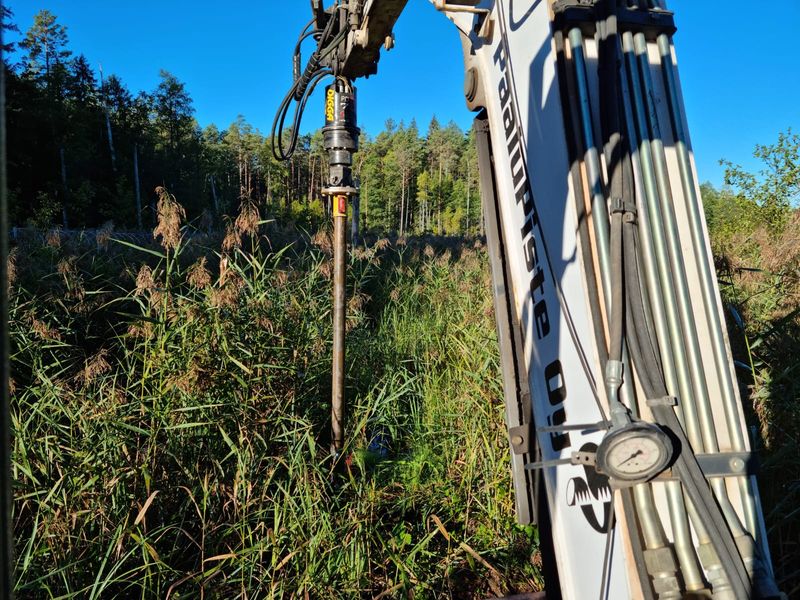
Screw piles are already known as a versatile and efficient deep foundation solution for contemporary civil engineering. They’re easy to install, have minimal environmental impact, while providing highly reliable load-bearing capabilities. All of which makes them an attractive alternative to traditional foundation solutions. So, as a civil engineer, what do you need to know about helical piles and their applications?
The Role of Screw Piles in Civil Engineering
Technical overview and components
Helical screw-piles carry load through the Helical end bearing plate. The helices enable the pile to be “screwed” into the ground without the need for prior excavation. And that’s what sets them apart from other pile foundations. Their main components include:
- Steel shaft: Typically hollow tubular or solid square sections, designed to transfer axial and lateral loads.
- Helical plates: Circular steel plates with defined pitch and diameter, responsible for load transfer to the surrounding soil.
- Pile head: Connects the pile to the structure, often customised depending on load conditions.
Installation usually takes place through the use of hydraulic torque motors, although hand installation is also possible on highly sensitive sites. The torque directly influences the pile’s load-bearing capacity. And the piles are ready for load-bearing immediately. That and the lack of excavation, spoil, and site disturbance has played a significant role in the growing popularity of screw piles.
Load-bearing capacity and performance
The load capacity of screw piles is derived from two primary mechanisms: end-bearing resistance and shaft friction. However, unlike conventional piles, helical piles rely heavily on the bearing resistance of each helix plate.
A commonly used empirical relationship links installation torque (T) to ultimate capacity (Q):
Q = K × T
Where:
Q = ultimate axial capacity
T = installation torque
K = torque factor (dependent on soil type and pile geometry)
Typical torque factors range between 8 and 12 m⁻¹ for cohesive soils and may vary in granular conditions. Engineers must calibrate these values based on site-specific geotechnical data.
Helical Screw piles perform well under:
- Compression loads: Supported by helix bearing
- Tension loads: Ideal for uplift resistance due to helix anchorage
- Lateral loads: Dependent on shaft stiffness and soil interaction
Design considerations
Designing screw pile foundations requires careful understanding of a range of factors:
Soil conditions
Screw pile performance is impacted by the ground conditions they are installed in. They are particularly effective in soft clays, silts, and loose sands, but cannot be deployed in solid rock or gravel that is more than 60% of the pitch.
Helix configuration
The number, spacing, and diameter of helices must be selected to ensure they bear on undisturbed soil. Typical spacing is at least three times the helix diameter to avoid overlapping stress zones.
Installation monitoring
Real-time torque monitoring must be used during installation to ensure that piles are fit for purpose.
Settlement behaviour
When properly designed and installed, settlement tends not to impact screw piles. However, that is reliant on the right screw piles and torque being used for the conditions.
Applications in civil engineering
Screw piles are highly adaptable and used across a broad range of projects:
- Temporary structures – Site offices, scaffolding supports, and event structures.
- Renewable energy systems – Solar panel arrays, wind turbine foundations, BESS infrastructure.
- Communication towers – Telecom towers subjected to wind-induced tension forces.
- Residential and commercial foundations – Housing projects, especially in areas with poor soil conditions where traditional shallow foundations are not viable.
- Infrastructure and retrofitting – Underpinning existing structures, slope stabilisation, and boardwalk or bridge support.
Helical screw-piles aren’t new. They’ve been around since 1833, but it’s only in the last few decades that their potential has been fully explored. With structural development, they have come to combine efficiency, performance, and sustainability. For civil engineers, that opens up a huge array of possibilities. Paving the way for faster and more environmentally responsible construction methods.
Does your business need support with reliable screw pile design, supply, or installation? Get in touch with UK Helix.