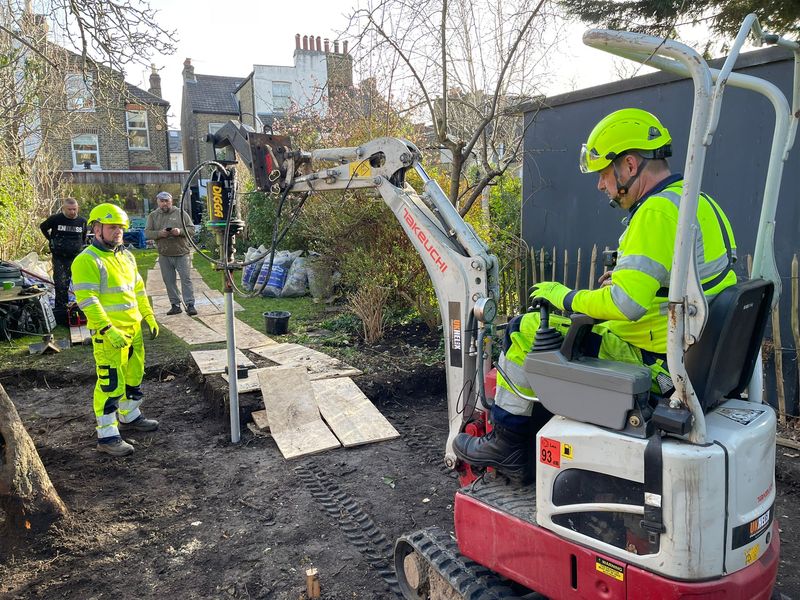
Excavation and construction have always gone together. But with rising muck-away costs and increasing pressure on site logistics, finding ways to reduce spoil is becoming invaluable for contractors. While immediate groundworks have become the focus for achieving that, considering alternative foundation solutions can also be instrumental in reducing spoil. So, how can you achieve this without compromising structural performance?
Foundations, Spoil, and Construction Site Logistics
Reducing excavation requirements
Traditional foundations involve substantial excavation. Whether you’re installing strip foundations, pads, or ground beams, there’s almost always a lot of soil to remove before construction can begin. Choosing alternative foundation systems can be a good way to address this.
Helical screw piles are installed directly into the ground by rotating the pile into position. They don’t require conventional excavation and generate very little spoil. So, you have fewer groundworks operations, less site prep, and the ability to instantly load. They won’t be suitable for every site or every project, but that applies to every foundation type. And where conditions are appropriate, they can offer a much simpler approach to foundation installation.
Managing rising muck-away costs
Spoil removal is one of those project costs that can easily be underestimated. It’s not just about paying for waste disposal. There are also loading operations, skip or grab lorry hire, transport, labour, and potentially additional costs associated with waste classification and disposal. And prices are continuing to rise.
By using foundation systems that need minimal ground disturbance, you can significantly reduce the volume of spoil generated. And that’s one of the reasons why helical screw piles are being used for an increasingly wide array of projects.
Reducing site traffic and disruption
Another benefit is that reduced spoil means fewer vehicles. Every additional vehicle arriving on site brings logistical issues. And that’s a major concern on restricted sites, urban developments, and projects with limited access. Vehicle movements can also create congestion, increase disruption, and introduce additional health and safety considerations.
Minimising excavation and spoil removal means that you reduce the number of vehicles that need to access the site.
Keeping sites cleaner and improving programme efficiency
Excavation is also very messy, no matter how much care you take. Stockpiled soil, mud, open trenches, and spoil heaps can make it harder to maintain a clean and organised site. They also create additional work for the team.
Reducing the need for excavation helps to keep working areas clearer and easier to manage. There’s less loose material to deal with, fewer excavations to protect, and less risk of soil being tracked across the site.
It can also help expedite job completion. Traditional foundations are time-intensive. There’s not just the problem of excavation and spoil, but preparation, concrete placement, and curing. And with curing being so weather-dependent, it’s easy to lose time. Screw piles are ready for use as soon as they’re installed. You need to test them for load-bearing, but once that’s done, construction can continue.
A more efficient approach to foundation installation
Minimising excavation and spoil removal isn’t simply about reducing the amount of muck that leaves a site. It’s about improving the way the entire construction process works. By considering alternative foundation solutions early, you can reduce unnecessary groundworks, manage site traffic, improve housekeeping, and create opportunities to accelerate installation programmes.
At UK Helix, we supply high-quality helical screw pile foundations, and can design and install them for you too.
If you’re looking to reduce groundworks costs, minimise site disruption or improve programme efficiency, get in touch with UK Helix to discuss how screw piles could benefit your next project.